Automate Christmas Lights in Canada: Outdoor Smart Plugs
Quick verdict: one outdoor plug, one indoor plug, and a sunset trigger
In Quebec the sun sets as early as 4:10 p.m. in December: if you plug your lights in by hand, they are off by the time you get home from work, or on all day for nothing. A smart plug solves that for the price of a restaurant dinner, with no subscription.
What to keep in mind before buying:
- Never put an indoor plug outside. It cracks in the cold, fills with slush and trips the GFCI breaker. Look for a plug certified CSA, cUL (or ETL) with an IP64 or IP65 rating.
- Cold is the real criterion. Read the temperature range on the spec sheet: -20 °C is a reasonable minimum for Canadian winters.
- Signal matters as much as the plug. An outdoor Wi-Fi plug needs a good 2.4 GHz signal; a proprietary-frequency system gets through brick or stone walls better.
- No subscription is needed to schedule lights, whether Wi-Fi, Matter or Clear Connect.
The lineup:
- Best value outdoors: TP-Link Kasa Smart Outdoor Plug (KP400 or EP40). Two independent outlets, IP64, CSA/ETL certified. Weak point: a good 2.4 GHz Wi-Fi signal is a must.
- Most reliable in deep cold: Lutron Caséta Smart Outdoor Plug. Clear Connect, IP65, -20 °C to 50 °C. Weak point: high price and a Lutron bridge is required.
- To replace ladder-hung lights: Govee Permanent Outdoor Lights. Permanent lighting, IP65/IP67. Weak point: careful installation in mild weather, before the hard freeze.
- For the tree and living room: indoor Matter or Wi-Fi plug (Tapo P125M or Amazon Smart Plug). Weak point: strictly indoor use.
Quick comparison
| Model | Use | Protection rating | Temperature range | Protocol | Local Home Assistant control | Approximate price |
|---|---|---|---|---|---|---|
| TP-Link Kasa Smart Outdoor Plug (KP400 or EP40) | Outdoor, dual outlet | IP64 | Check the spec sheet (be careful below -20 °C) | 2.4 GHz Wi-Fi | Yes, local integration | Around $35 – $60 |
| Lutron Caséta Smart Outdoor Plug | Outdoor, deep cold | IP65 | -20 °C to 50 °C claimed | Clear Connect (Caséta bridge required) | Yes, via the bridge, locally | Around $70 – $110 (bridge extra) |
| Govee Permanent Outdoor Lights | Outdoor, permanent lighting | IP65 or IP67 depending on model | Check by model | Wi-Fi, Matter depending on model | Depends on model (Matter or integration) | Around $150 – $350 depending on length |
| Tapo P125M (or Amazon Smart Plug) | Indoor: tree, village, living room | None (indoor only) | Indoor only | Wi-Fi + Matter (Tapo P125M) | Yes via Matter (Tapo P125M) | Around $12 – $30 |
Approximate prices in Canadian dollars, to check on Amazon.ca before buying. Temperature ranges and protocols vary by version: read the product page.
Outdoor plugs: what changes in Canada
An outdoor plug, not an indoor plug under a plastic bag. Cheap indoor plugs are not built for moisture: the plastic turns brittle below zero, slush gets in, and leakage current trips the GFCI breaker, often in the middle of the night.
CSA, cUL or ETL certification. It attests to electrical safety for the Canadian market. An IP rating alone is not enough: look for the certification mark on the product and on the Amazon.ca listing.
IP64 or IP65. The first digit is dust protection (6 = dust-tight), the second is water protection: 4 for splashes, 5 for low-pressure jets. Both suit a sheltered plug; IP65 gives more margin against slush and freezing rain.
Temperature range. At -25 °C, a battery or capacitor can misbehave. Aim for a product rated to -20 °C and shelter it under an overhang or soffit.
Signal. A Wi-Fi outdoor plug 8 m from the router, behind brick and vinyl, drops off fast. Test the signal before sticking up the lights, or pick a proprietary-frequency system.
The 4 products in detail
TP-Link Kasa Smart Outdoor Plug (KP400 or EP40)
TP-Link Kasa Smart Outdoor Plug (KP400 or EP40)
Pros
- Two independently controlled outlets
- Weather-resistant IP64 housing, CSA/ETL certification
- Local Home Assistant integration, works with Alexa and Google Home
- Affordable for a dual outdoor plug
Cons
- Needs a good 2.4 GHz Wi-Fi signal outdoors
- The rubber caps must be closed tightly if only one outlet is used
- Check the temperature range on the spec sheet before deep cold
- The Kasa app and an account are required for initial setup
Lutron Caséta Smart Outdoor Plug (PD-15OUT-BL)
Lutron Caséta Smart Outdoor Plug (PD-15OUT-BL)
Pros
- Operating range claimed from -20 °C to 50 °C
- Very rugged sealed IP65 housing
- Clear Connect: gets through brick and stone walls without outdoor Wi-Fi
- Local Home Assistant integration via the Caséta bridge
Cons
- Much higher price than Wi-Fi plugs
- Requires the Lutron Caséta Smart Bridge
- One controlled outlet per device, unlike dual models
Govee Permanent Outdoor Lights
Govee Permanent Outdoor Lights
Pros
- Architectural lighting: elegant warm white or holiday colors
- IP65/IP67 waterproofing
- Works with Matter, Home Assistant and Alexa depending on the model
- No strings to hang and store every year
Cons
- Needs careful installation under soffits, in mild weather before the hard freeze, so the adhesive holds
- Bigger budget than simple string lights
- Check Matter and Home Assistant support for your exact model
- The Govee app and an account are often required for advanced settings
Indoor Matter or Wi-Fi smart plug (Tapo P125M, Amazon Smart Plug)
Indoor Matter or Wi-Fi smart plug (Tapo P125M, Amazon Smart Plug)
Pros
- Compact format that does not block the second wall outlet
- Scheduling and instant voice control
- The Tapo P125M supports Matter, so it works locally in Home Assistant
- Very affordable: you can buy several
Cons
- Strictly indoor use, 120 V, dry location
- The Amazon Smart Plug is mainly built for Alexa, with less openness to Home Assistant
- Do not exceed the load printed on the plug, especially with older light strings
4 magical holiday automations
These routines work with Home Assistant, Alexa or Google Home. If you do not have a hub yet, read our guide to installing Home Assistant on a mini PC or our step-by-step Alexa guide.
1. Turn on at sunset, off at 11:30 p.m.
In December the sun sets early. Turning the lights on 15 minutes before sunset avoids the “dark house” effect when you arrive home. Switching off at 11:30 p.m. also trims consumption. In Home Assistant:
alias: Christmas - on at sunset
trigger:
  - platform: sun
    event: sunset
    offset: "-00:15:00"
action:
  - service: switch.turn_on
    target:
      entity_id:
        - switch.outdoor_lights
        - switch.living_room_tree
And the switch-off:
alias: Christmas - off at 11:30 p.m.
trigger:
  - platform: time
    at: "23:30:00"
action:
  - service: switch.turn_off
    target:
      entity_id:
        - switch.outdoor_lights
        - switch.living_room_tree
In Alexa or Google Home, create a routine with a sunset trigger (-15 min offset if offered) and a second one at 11:30 p.m.
2. The “Alexa / Hey Google, it’s Christmas” voice scene
One phrase turns on the tree and the outdoor lights and starts a holiday playlist. In the Alexa app, create a routine with the phrase “it’s Christmas”; add the plugs, then a music action on your Echo speakers. In Google Home, create a routine with the voice command “it’s Christmas”. No subscription is needed for the routine itself; the music depends on your service (some free tiers have ads).
3. “Guests arriving / New Year’s Eve” mode
On party night, the entryway and tree lights turn on as soon as the door or doorbell detects someone. In Home Assistant, trigger on a door sensor or doorbell, with an “after sunset” condition:
alias: Christmas - guests arriving
trigger:
  - platform: state
    entity_id: binary_sensor.front_door
    to: "on"
condition:
  - condition: sun
    after: sunset
action:
  - service: switch.turn_on
    target:
      entity_id:
        - switch.outdoor_lights
        - switch.living_room_tree
4. Safety: “Off to visit the family”
When everyone leaves the house, the indoor tree switches off automatically. In Home Assistant, trigger when the number of people at home drops to zero (phone-app location):
alias: Christmas - tree off when away
trigger:
  - platform: state
    entity_id: zone.home
    to: "0"
action:
  - service: switch.turn_off
    target:
      entity_id: switch.living_room_tree
Keep the outdoor lights on a schedule: they help deter break-ins when the house is empty. To track the usage of your whole home, see our guide on measuring your Hydro-Québec consumption.
Winter electrical safety in Canada
- GFCI-protected circuit outdoors. Plug every outdoor plug into a circuit protected by a GFCI breaker or receptacle. If it trips, it is usually water or snow: do not bypass it.
- Raised connections. Keep connections out of slush and ice: mount them on a support, under an overhang, with a drip loop in the cord.
- Respect the maximum load. A standard 120 V / 15 A outlet supports at most 1,875 W. For a load left on for hours, stay well under (about 80 %, or 1,440 W). Add up the wattage of your light strings before plugging in.
- Outdoor-rated extension cords only, of a suitable gauge, fully uncoiled.
- If in doubt about the installation, call an electrician: a missing or poorly protected outdoor circuit is not something to fix with a smart plug.
Which choice for your situation
- You want lights on the balcony or front of the house, with no hassle: Kasa KP400 or EP40, with a good Wi-Fi signal.
- You have a brick wall or a big yard, or you fear deep cold: Lutron Caséta and its bridge.
- You are tired of climbing the ladder every year: Govee Permanent Outdoor Lights, installed in mild weather.
- You just want the tree and the village on voice control: Tapo P125M or Amazon Smart Plug.
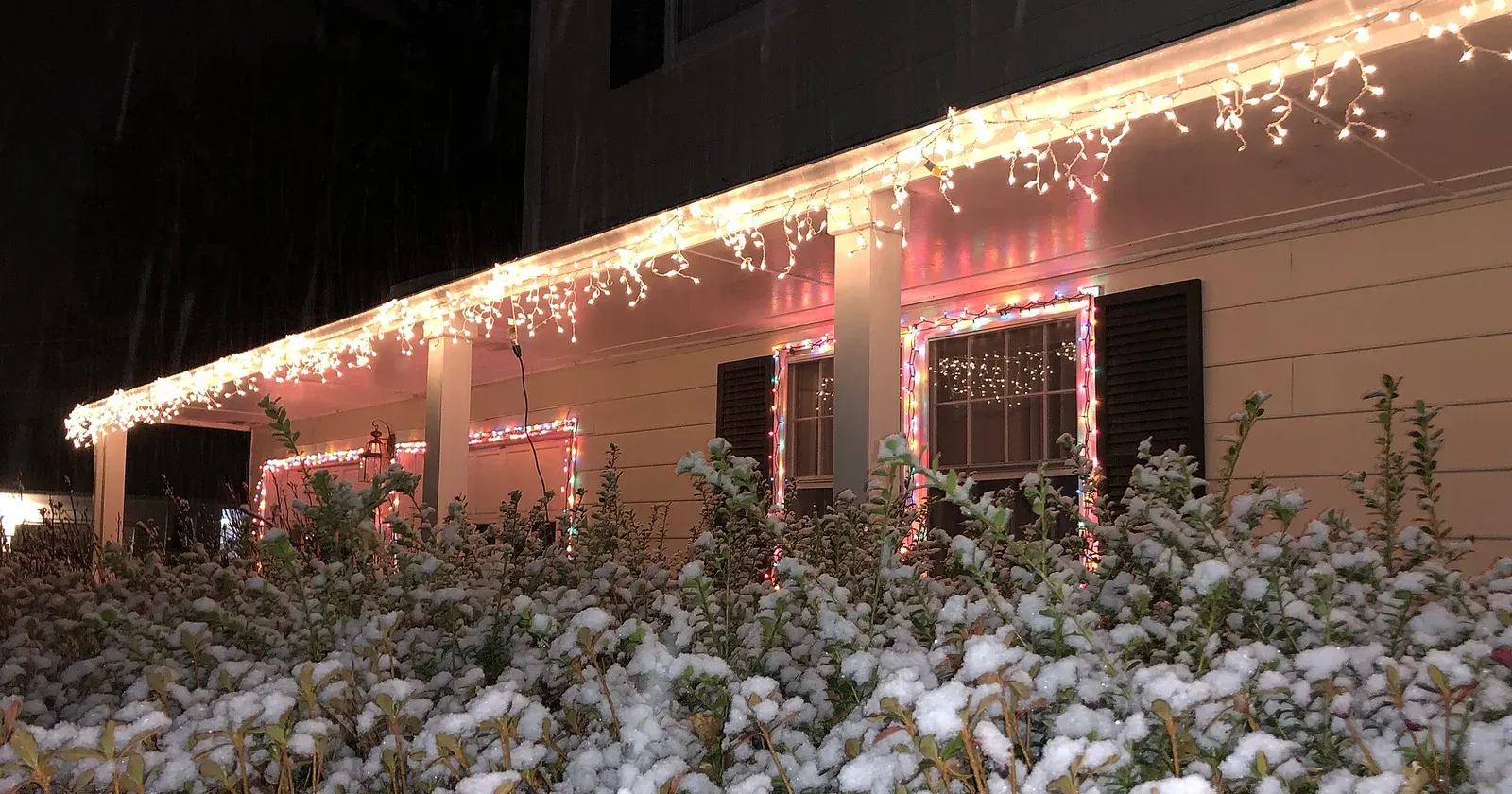
Photo: “Snow and Christmas lights on a house at night”, Famartin, Wikimedia Commons, CC BY-SA 4.0 (cropped and converted).
Frequently asked questions (FAQ)
Can I leave an outdoor smart plug plugged in at -30 °C in a Canadian winter?
Only if the manufacturer rates it for that range. Many outdoor plugs are rated down to about -20 °C, and the Lutron Caséta is rated from -20 °C to 50 °C. Below the rated range, plastic gets brittle and the electronics can drop out or restart erratically. Put the plug under an overhang, close the caps tightly, keep the connection out of the snow and check the spec sheet before you buy.
What is the difference between IP64 and IP65 for Christmas lights?
The first digit is dust protection: 6 means dust-tight. The second digit is water protection: 4 withstands splashing from any direction, 5 withstands low-pressure water jets. For decorations exposed to slush and freezing rain, IP65 gives you extra margin. Neither rating replaces CSA or cUL certification, which covers electrical safety.
How much does a tree and LED decorations cost to run on Hydro-Québec power for a month?
Very little. As an example, 50 W of LED strings on for 7 hours a day over 30 days use about 10 kWh. At Hydro-Québec's residential rate of roughly 7 to 11 cents per kilowatt-hour depending on the tier, that is on the order of $1 a month. Old incandescent strings use several times more, and the cost climbs fast. Check the wattage printed on your strings.
How do I control Christmas decorations with no subscription using Home Assistant or Alexa?
The Wi-Fi, Matter or Clear Connect plugs in this article work with no subscription. In Home Assistant, add the plug's integration, then build an automation triggered by sunset. In Alexa or Google Home, create a routine triggered by sunset or a voice phrase. Manufacturer apps and voice routines are free.